Brand Standards
The Roster Memo Brand
The official reference for how Roster Memo looks, reads and is reproduced. It governs the website, the newsletter, social channels, share cards and anything printed.
§1 The principle
Roster Memo is built on two forces held in deliberate tension. The ballclub owns the words: a script wordmark, letterpress rules and aged paper, the feel of a front office that has been around. The lab owns the numbers: stark white figures, modern sans and mono type, no ornament. Every surface the brand touches belongs to one side or the other, and the two never blur.
The ballclub
Words, judgment, the memo
- Script wordmark, Old Standard TT, Source Serif 4
- Ballpark Paper, Club Navy, Stitch Red
- Double rules, letterhead, the routing block
The lab
Numbers, charts, tables
- Inter and IBM Plex Mono
- Figure White, Data Ink, four series colors
- Hairlines, a source line on every chart
§2 The mark
The wordmark is Roster Memo set in a ballpark script, drawn as fixed outlines so it renders identically everywhere. Its underline tail is always red: Stitch Red on light grounds, its night-game tint on dark ones. It is the only script used anywhere in the brand.

Clear space and size
- Clear space: keep free space around the wordmark equal to the height of its capital R on every side.
- Minimum size: 120 pixels wide on screen, 1 inch in print. Below that, use the monogram.
- Grounds: Ballpark Paper, Figure White or Club Navy. Never a photograph or pattern.
Not permitted
Also not permitted: retyping the name in a script font, adding effects, or redrawing any club's script.
§3 Color
Two palettes, one for each side. Club colors carry the words; lab colors carry the data. Don't mix them in one element.
Club palette
Club Navy
#0B2545 · RGB 11, 37, 69
The wordmark, rules, headers and the masthead. The brand's anchor color.
Stitch Red
#C8102E · RGB 200, 16, 46
The wordmark's tail, kickers and alerts. Used sparingly, never for large fields.
Ballpark Paper
#F4EDDF · RGB 244, 237, 223
The page. Every surface that carries words sits on paper.
Press Ink
#1C1A17 · RGB 28, 26, 23
Headlines and reading text.
Program Gray
#4F4A41 · RGB 79, 74, 65
Secondary text: deks, captions, bylines.
Scorecard Rule
#D8CFBC · RGB 216, 207, 188
Hairlines and borders on paper.
Lab palette
Figure White
#FFFFFF · RGB 255, 255, 255
The frame every chart and table sits in.
Data Ink
#111827 · RGB 17, 24, 39
Numbers, axis labels and table text.
Series 1
#2A78D6 · RGB 42, 120, 214
First series in any chart.
Series 2
#EB6834 · RGB 235, 104, 52
Second series; also below-average values.
Series 3
#1BAF7A · RGB 27, 175, 122
Third series.
Series 4
#EDA100 · RGB 237, 161, 0
Fourth series.
Series colors are used in this fixed order and were chosen to stay distinct for colorblind readers. Every text and background pairing on the site meets WCAG AA contrast. The dark theme, "the night game," shifts each color to a lighter tint of the same hue.
§4 Typography
Grand Hotel
The wordmark only, as fixed outlines. Never typed as a font.
Old Standard TT
Headlines, memo titles, section heads. Bold 700.
Where the numbers go quiet
Source Serif 4
Reading text: memos, studies, desk reports.
The recommendation comes first, the evidence in about a page, the methods in an appendix.
Inter
Interface and chart labels.
Expected wins · 80% range · Depth value
IBM Plex Mono
Every number in a table, kickers, the ticker and datelines.
100.1 89.9–110.3 +5.6 $27M
Numbers are always set in IBM Plex Mono or Inter with tabular figures, so columns align. Script never appears outside the wordmark.
§5 Voice
Roster Memo writes like a front office memo: direct, specific and accountable.
- Lead with the finding.
- The number or the recommendation comes first. "The Dodgers' rotation projects 5.6 wins above average," not "We looked at rotations."
- Show the number and its range.
- Every projection travels with its uncertainty. A single figure without a range overstates what anyone knows.
- Say where the numbers go quiet.
- Where public data can't rank players well, say so plainly and mark it. That is where judgment from a decade in Triple-A comes in, and the brand names it rather than hiding behind a decimal.
- Facts in the data, judgment in the memo.
- Charts, desk reports and social posts state what the numbers show. Recommendations belong to the author, under his name.
- No hype.
- No "shocking," "insane" or "must-see." No emoji in editorial copy. Club and player names in full on first reference.
- Credit every source.
- Every chart carries a source line. Data from Retrosheet, MLB and Baseball Savant is credited where it appears.
§7 Downloads
Approved files for press, partners and anyone writing about Roster Memo. Use them as supplied.
- Wordmark, primaryNavy with red tail. SVG.
- Wordmark, reversedPaper with night-game red, for navy or dark grounds. SVG.
- Wordmark, one colorPress Ink throughout, for print, stamps and embossing. SVG.
- MonogramThe R on a navy tile. Favicons and small spaces. SVG.
- Profile image, navy400 × 400 PNG. X, Bluesky, Substack.
- Profile image, cream400 × 400 PNG. Alternate for dark feeds.
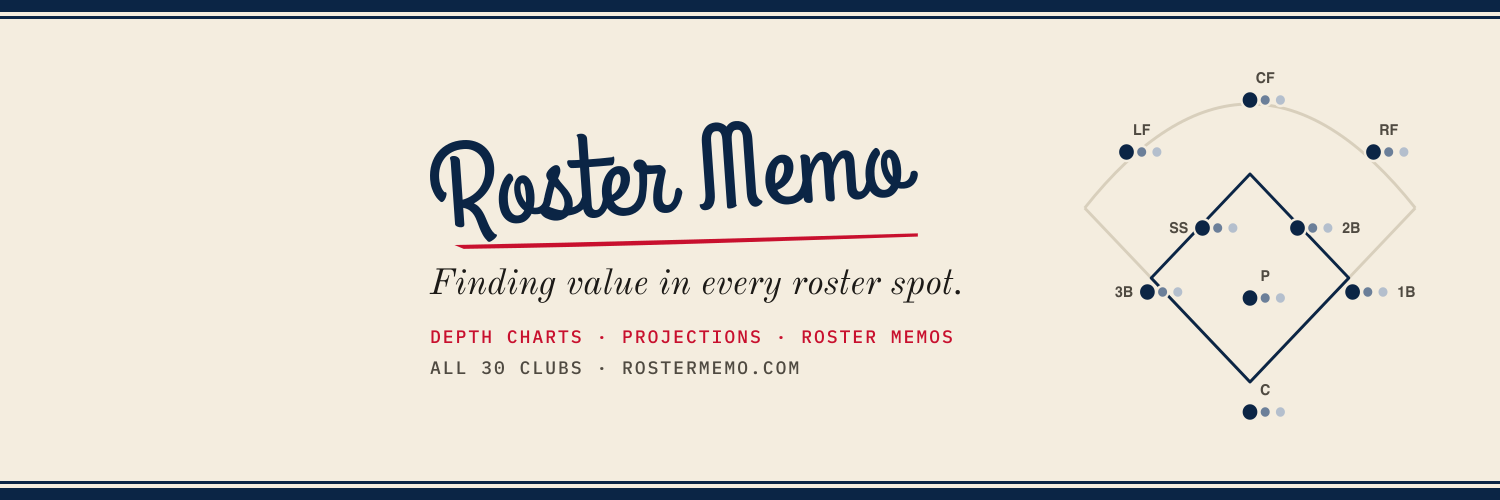
- Profile banner1500 × 500 PNG. X and Bluesky headers.





§8 Usage and trademarks
The Roster Memo name, wordmark and monogram identify this publication. Press and readers may use the supplied files to refer to Roster Memo, unaltered, provided the use doesn't suggest endorsement. For any other use, ask first.
Roster Memo is independent. It is not affiliated with Major League Baseball or any club. Team names, logos and player photographs on this site are the property of their owners, are used to identify clubs and players, and are not part of the Roster Memo brand. Don't combine them with the Roster Memo mark in a way that suggests a partnership.
Edition 1.0 · Issued Nov. 8, 2026 · Superseded by any later edition posted here.
§6 Social profiles
The same identity on every channel: the navy avatar, the banner, and the handle @rostermemo.